The problem
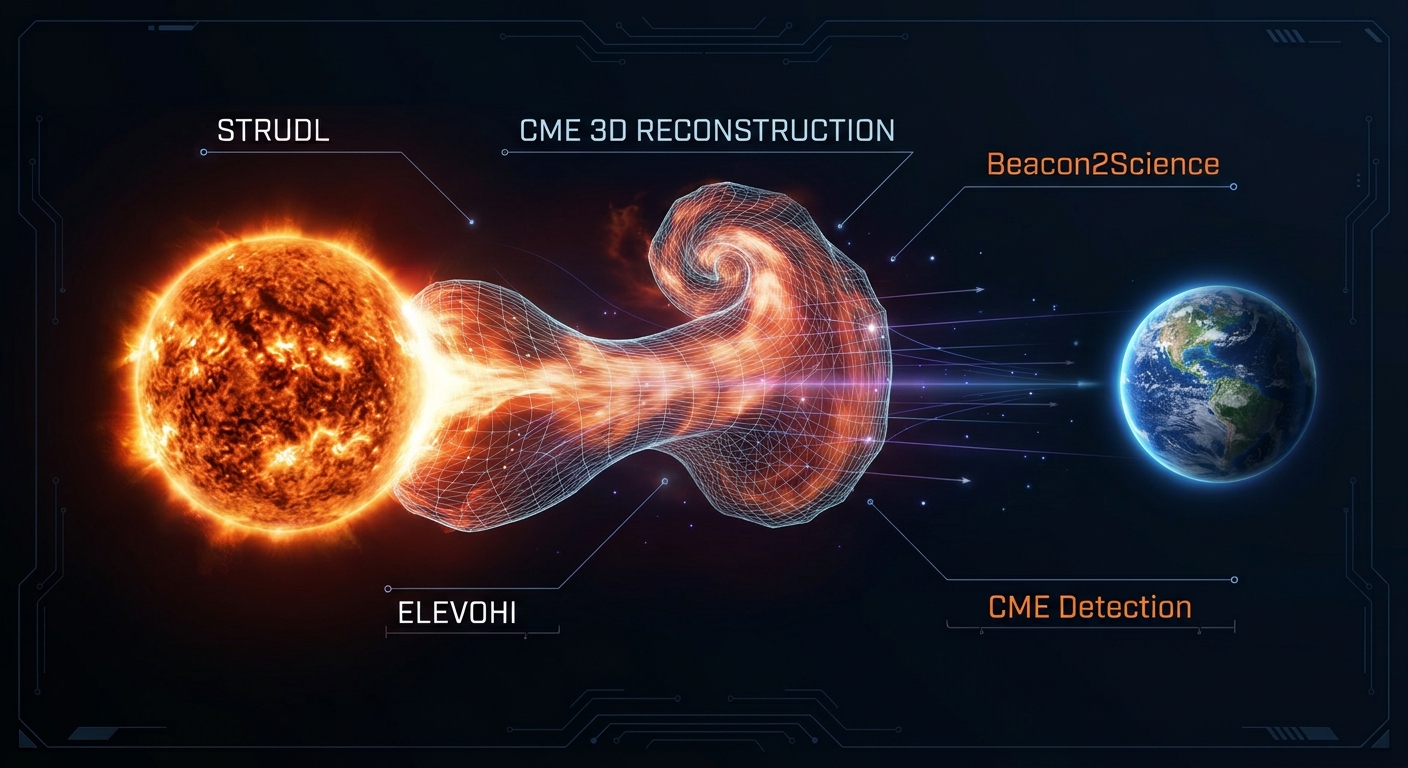
Coronal mass ejections (CMEs) are huge eruptions of plasma and magnetic field from the Sun. When one hits Earth it can trigger a geomagnetic storm that threatens satellites and power infrastructure. Coronagraphs only see a CME close to the Sun, out to about 30 solar radii, which is a little over 13% of the Sun–Earth distance. Heliospheric imagers (HI) on spacecraft like STEREO watch the whole space between the Sun and Earth, so a CME can be followed from its origin to its impact.
Making that useful for forecasting raises three problems:
- Real-time HI data is poor. The fast “beacon” images are much lower quality than the science data.
- CMEs are still tracked by hand. This is slow and subjective.
- We need arrival times. Tracking has to turn into a forecast.
This project tackles all three. It is part of the FWF-funded project Improved Solar Storm Modelling with Machine Learning at GeoSphere Austria.
Beacon2Science: making real-time data usable for CME tracking
STEREO sends two kinds of HI data:
| Science | Beacon | |
|---|---|---|
| Resolution | 1024 × 1024 px | 256 × 256 px |
| Cadence | 40 min | 120 min |
| Availability | ~4 days later | Near real time |
Earlier work concluded that beacon data could not match science data for CME arrival forecasting. Beacon2Science is a pipeline designed to close that gap.
How it works
- Denoising and upsampling: a GAN-based network improves signal-to-noise ratio and spatial resolution, while staying consistent between consecutive frames.
- Cadence upsampling: a flow-based network infers CME motion between images and generates interpolated frames.
- Front segmentation and tracking: running differences and time-elongation maps (J-plots) are built from the enhanced images.
What we found
- The enhanced images show CME features more clearly than the original beacon data and are comparable to science data.
- CME fronts stay more visible at larger elongations in the HI-1 field of view.
- The smoother J-plots help tracking closer to science data.
- The main issue with Beacon-data for forecasting lies within the datagaps, which should be considered for future missions.
My contribution: I developped the method, gathered datasets, and coded pytorch models and pipeline and their evaluation and drafted the Publication.
STRUDL: CME front detection in Heliospheric Imager data
Project led by Maike Bauer during her PhD at the Austrian Space Weather Office.
STRUDL (Solar Transient Recognition Using Deep Learning) automatically detects and segments CME fronts in HI images. It was trained on thousands of images from STEREO-A. From the segmented regions it derives the CME front itself, which can then be tracked. STRUDL reliably detects and tracks strong CMEs. Weak and overlapping events remain hard, and performance improves with more training data. We can futher use the tracks to forecast the CME arrival time and this is currently being investigated in ongoing work.
My contribution: I worked with Maike Bauer as her main supervisor and contributed to the developpement of the deep-learning model, training method and annotations.
Forecasting arrivals from L5
Predicting CME arrival time using HI data seemed to be highly dependent on the lenght of the tracks. In this study we looked at how the lenght of the tracks affected the performances of CMEs’ arrival time forecasting, when the spacecraft would be positioned around the L5 point, similarly to the future Vigil Mission.
My contribution: I helped develop the tracking tool used during this study and was one of the three scientists in charge of tracking all the CMEs in the paper. I further helped in commenting and improving the manuscript.
Next and OnGoing: coronagraphs and multiple viewpoints
Most forecasting and propagation models rely on manual detection and public catalogues such as DONKI, but automatic CME detection and reconstruction is progressing fast and we propose to build a whole pipeline to detect, track and reconstruct CMEs from multiple coronagraphs view-points to use for forecasting and building large statistical CME catalogues from historical data.
Results presented at ESWW 2025 and 2026 and published soon
- New deep-learning instance segmentation model to detect CMEs in LASCO C2 and STEREO COR2-A/B.
- Temporal tracking to obtain height, position angle and speed.
- Differentiable GCS-style 3D mesh fitted to multi-view masks to recover direction, extent and orientation => initialise propagation models.
- Automatic detection and reconstruction => less observer bias & enables large statistical studies of CME rates, kinematics and morphology.
- Fully automatic near-real-time forecasting.
- With ESA’s Vigil mission at L5 and future L1 and L4 mission, it will help and constrain CME forecasting and analysis.
Talks and posters
- ESWW 2023, Toulouse, France, Enhancing STEREO-HI data with machine learning for efficient CME forecasting (Poster)
- EGU General Assembly 2024, Vienna, Austria, Enhancing STEREO-HI data with machine learning for efficient CME forecasting (contributed Talk)
- PUNCH5 Science Meeting 2024 Boulder, USA, Enhancing STEREO-HI data with machine learning for efficient CME forecasting and multi-spacecraft observations (contributed Talk)
- PUNCH5 Science Meeting 2024 Boulder, USA, Automated detection and tracking of CMEs using HI instruments (poster, Bauer et al.)
- COSPAR 2024 Busan, Korea, Enhancing STEREO-HI beacon data with machine learning for efficient CME forecasting (contributed Talk)
- ESWW 2024, Coimbra, Portugal, CNN-based detection and tracking of CMEs in HI data (Talk, Bauer et al.)
- ESWW 2024, Coimbra, Portugal, Enhancing STEREO-HI beacon data with machine learning for improved near-real-time CME forecasting (Poster)
- Space-weather science from the fifth Lagrange point, London, UK, Space weather prediction pipeline for real-time heliospheric imaging data (contributed Talk)
- ESWW 2025, Umeå, Sweden, Toward Operational Space Weather: Automated 3D CME Reconstruction (Poster)
- ESWW 2025, Umeå, Sweden, Automatic Real-Time CME Detection and Forecasting using STEREO-HI Beacon Data (Poster, Bauer et al.)
- ESWW 2026, Florence, Italy, Automatic CME detection, tracking and reconstruction in coronagraphs (Poster)
- ESWW 2026, Florence, Italy, Assessing the use of automatic CME tracking in HI within a drag-based forecasting pipeline (Talk, Bauer et al.)
Publications
- Beacon2Science: Enhancing STEREO/HI beacon data with machine learning for efficient CME tracking
J. Le Louëdec, M. Bauer, T. Amerstorfer, J. A. Davies · Space Weather 23(7), e2025SW004440, 2025 (first author) - Solar Transient Recognition Using Deep Learning (STRUDL) for Heliospheric Imager Data
M. Bauer, J. Le Louëdec, T. Amerstorfer, L. Barnard, D. Barnes, H. Lammer · Space Weather 23(9), e2025SW004561, 2025 (co-author) - Predicting CME Arrivals with Heliospheric Imagers from L5: A Data Assimilation Approach
T. Amerstorfer, J. Le Louëdec, D. Barnes, M. Bauer, J. A. Davies, S. Majumdar, E. Weiler, C. Möstl · Space Weather, 2026 (co-author)